Monetary Policy Report for October 2026
The Monetary Policy Report presents the Bank's technical staff's analysis of the economy and the inflationary situation and its medium and long-term outlook. Based on it, it makes a recommendation to the Board of Directors on the monetary policy stance. This report is published on the second business day following the Board of Directors' meetings in January, April, July, and October.
During the third quarter, inflation continued to rise, moving further away from the 3% target. At the same time, the economy, which had been growing at a good pace, was affected by the earthquake and showed signs of moderation. Inflation is expected to continue rising for the rest of 2026 and begin to ease in 2027, moving closer to 3% in 2028. In this context, Banco de la República remains committed to taking the necessary measures to gradually bring inflation back to its target.

Inflation continued to rise during the third quarter of the year, driven mainly by high labor costs, spending that remains above the economy’s productive capacity, the effects of the El Niño phenomenon on prices, and adjustments to some services that are based on past inflation. These pressures are expected to persist through the rest of 2026 and begin to ease in 2027.
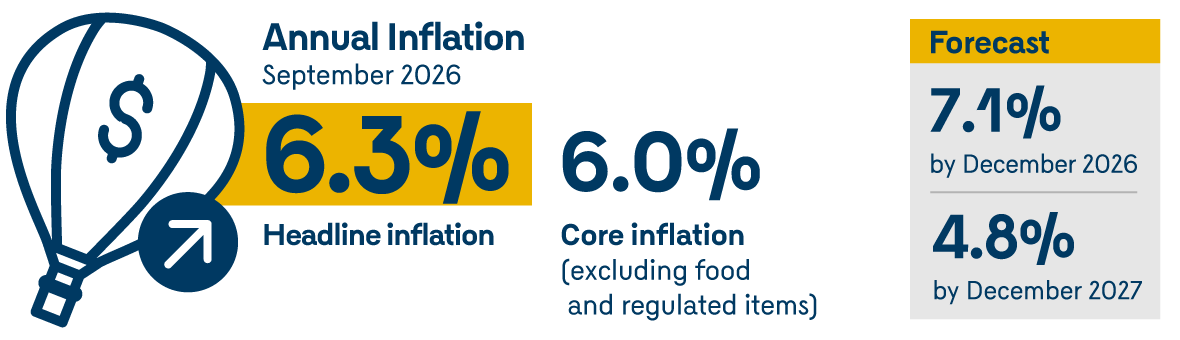
- In September, prices rose 6.3% year-on-year, up from 6.1% in June. Prices for the less volatile goods and services in the consumer basket (excluding food and regulated items) increased at an annual rate of 6.0%, similar to the rate recorded in the previous quarter.
- The faster pace of price increases was associated with high labor costs, aggregate spending that continues to exceed the economy’s productive capacity, the effects of El Niño phenomenon on food prices due to drought conditions, and adjustments to some services based on past inflation.
- Several factors helped contain price increases. One of them was the peso’s appreciation against the dollar, which makes goods and inputs that the country purchases and pays for in dollars less expensive.
- Looking ahead, the technical staff’s projections indicate that inflation will continue to rise through the rest of 2026, driven by labor costs, El Niño, the economy’s continued momentum, and the impact of the conflict in the Middle East on external prices and costs. Inflation is expected to begin easing in 2027 and move closer to 3% in 2028, supported by Banco de la República’s policy actions and the reversal of factors that have pushed prices higher.
- The above projections remain highly uncertain. Inflation could be affected by the intensity and duration of El Niño; the effects of possible changes in fiscal policy on economic activity and the exchange rate; the impact of the earthquake; developments in the conflict in the Middle East and their effects on international prices and the exchange rate; as well as adjustments to certain regulated prices.
The Colombian economy grew faster in the second quarter of 2026, driven mainly by increased household and public-sector spending and investment. Going forward, the economy is expected to continue growing, though at a more moderate pace, partly due to the negative impacts of the earthquake.
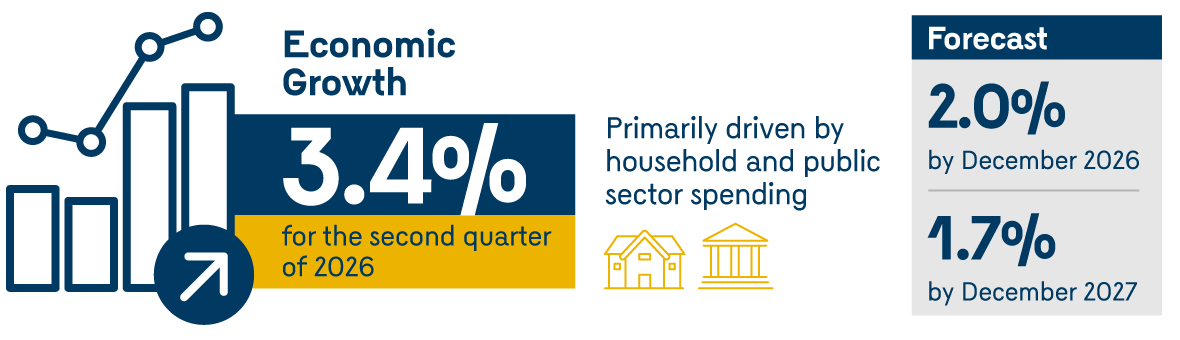
- In the second quarter of 2026, the Colombian economy grew 3.4% year-on-year, driven mainly by increased spending by households and the public sector, boosted by the presidential elections, the FIFA World Cup, and retroactive payments by local governments, among other factors. Increased investment, particularly in machinery and equipment, also contributed.
- The labor market continued to perform well, with more people employed and a lower unemployment rate than a year earlier. However, the latest data suggest that this trend is moderating.
- Economic activity would continue to grow in 2026 and 2027, although at a slower pace than recently observed. This is explained by the effects of the August earthquake, the moderation seen in the labor market, and the impact of below-average rainfall on agricultural food production.
- The Colombian economy continues to face significant uncertainty related to developments in the Middle East conflict, the country’s fiscal conditions, and the effects of the earthquake and weather events.
The Board of Directors of Banco de la República remains committed to gradually bringing inflation back to its 3% target. This goal is especially important at a time when prices are rising rapidly and spending by households, the public sector, and businesses remains above a level that would be sustainable in the long term.
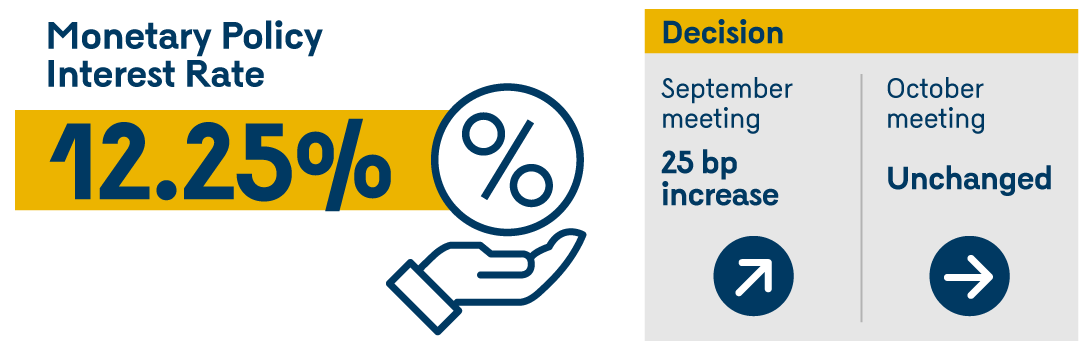
- In this context, at its September meeting, the Board of Directors decided to raise the monetary policy interest rate by 25 basis points and, in October, to leave it unchanged at 12.25%, maintaining a stance consistent with inflation returning to the 3% target within two years.
- Future policy actions will depend on new information about prices, economic activity, and developments in the identified risk factors.
Monetary Policy Presentation (only in Spanish)
Index of Boxes from the Report
 Box 1. Efectos macroeconómicos del terremoto en Colombia en el corto plazo (only in Spanish)
Cote-Barón, Juan Pablo
Pulido-Mahecha, Karen L.
Box 2. Eventos deportivos, apuestas y actividad económica: un canal de consumo en expansión (only in Spanish)
Chitan-Caes, Andrés Felipe
López-Contreras, María Alejandra
Gallego-Lamus, Nicole Valeria
Box 3. Pronóstico de la inflación en Colombia: experimentos con inteligencia artificial (only in Spanish)
Garavito-Acosta, Aarón Levi
Caicedo-García, Edgar
Ospina-Tejeiro, Juan José
Martínez-Rivera, Wilmer Osvaldo
 Reports
 Presentations (only in Spanish)
 Boxes